


The line between gambling and investing is artificial and thin. The soundest investment has the defining trait of a bet (you losing all of your money in hopes of making a bit more), and the wildest speculation has the salient characteristic of an investment (you might get your money back with interest). Maybe the best definition of “investing” is “gambling with the odds in your favor. - Michael Lewis
This is not a post about investing. It is not a post claiming you will be guaranteed to make millions. This is a proven framework. One that helps you make millions without any excuses. One focused on jobs, careers, and business. Something that works and has proven itself many times. Will it be easy? Nothing worth doing ever is. Does it work? You bet it does.

CONTENTS OUTLINE
You are starting from $0. No connections. No skills. No idea where to go… You are at zero.
Jobs, careers, and everything you need to know about them
Picking and building transferable skills
Setting up a foundation (career edition)
Getting your first money
The difference between making money and building wealth
Doing the math and reverse-engineering where you are now
Making your first sale
The traps you want to avoid (at this stage)
Running large(er) scale operations
Quitting your employer (when and how)
Service business limitations
Resisting temptations and lifestyle inflation
Building out the system (everyone should do it)
Accelerating (the multiplier phase)
Spending money to make more money
Focusing on what is already working
Equity (ownership)
Exit
Retirement
New start
What nobody warns YOU about
Money addiction
Health over everything
How success changes people
Levers for each stage of your journey
Making it easier for yourself
You need to be able to tell the difference and understand the underlying logic.
Job: Something where you are trading your time for money.
Career: Trading your performance for money. This is all about the results. Your goal is to always be in a position where you can earn income and get paid for your performance.
Uncapped income: A position where your earnings are not tied to time.
Performance-based pay: No commission > no performance > no pay > no real career.
PE: Private equity.
HF: Hedge fund.
Business: Something that allows you to make money while you are sleeping.
Conversion: % of the people who buy. If 1,000 people see your ads and 20 decide to buy your product, you are looking at a 2% conversion rate.
Margin: What it costs you and what you sell it for. The difference between the two is the margin.
Convert: Make a sale. Convert a prospect (visitor) into a buyer.
MVP: Minimum viable product.
SOP: Standard operating procedure.
VA: Virtual assistant.
SMB: Small to medium business.
3PL: Third-party logistics. Services that handle your e-commerce fulfillment.
Equity: Ownership. If done right, equity becomes something you look at in multiples.
Multiple: What the buyer pays. Imagine a business making $50k in profit per year, sold at a 4x multiple. You are looking at a $200k exit.
Multiples vary by business model.
Event: Liquidity moment. Selling a business.
NW: Your net worth (total value of everything you own)
Transferable skills: Unique to you. Something that can't be outsourced (easily) and takes time + effort.


The system we will be covering
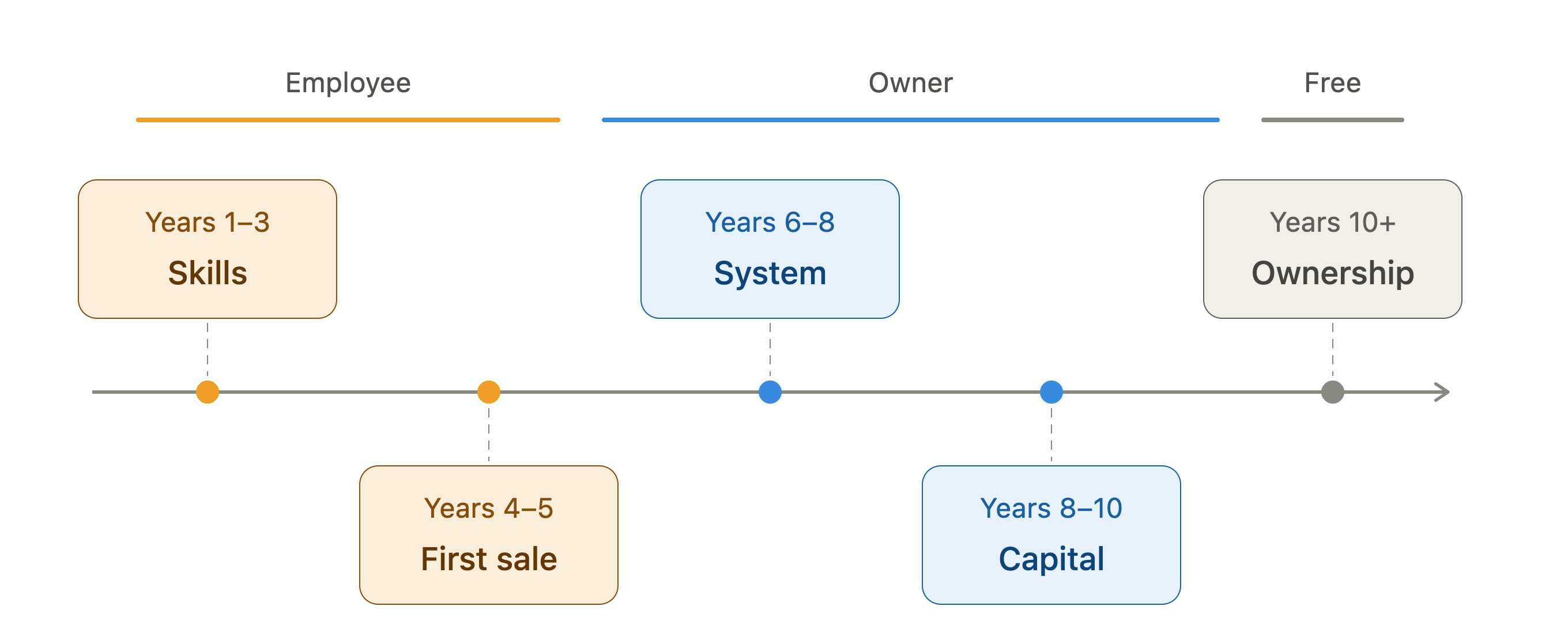
Years 1-3
Building the foundation (career, transferable skill set, and safety net).
Years 4-5
Reality check (transition from employee to owner).
Years 6-8
The compounding effect and early effort. Something that becomes visible across all areas of your life (income, assets…) + building out the system.
Years 8-10
What it takes to accelerate and take it to another level.
Years 10+
Retirement, life after exit, and everything else.
We recommend reading the post in chronological order. The quality of your reading experience is up to you. This is a long, dense read that will take at least an hour (more like an hour and a half). Our advice is to take your time with this.
1. You are starting at zero
Journey timeline: years 1-3
Jobs, careers, and everything you need to know about them
Jobs: The only time you want to take one is when you can't find another way to create an income stream. There is nothing worse for your long-term plans than being stuck in a position where you trade your time for money. The difference between a terrible job and a bad one? A bad one gives you a skill set you can transfer to your future adventures. Every other job? A terrible one.
Jobs = money-making machines for someone else.
Careers: Performance-based position. This is what you are aiming for and making your goal. Everything else is not worth your time and will only slow you down as you get older.
The best part about most performance-based roles (consulting, front-office finance, tech sales) is that the skill set is transferable because the complexity we deal with makes everything else look like it's three steps below what it will take to achieve the results.
Going for a performance-based position also helps you avoid the trap of feeling stuck. Can you sell? There is always a company out there that will pay you more to achieve the same results as other sales reps. Once you approach it as we have described here… It makes much more sense.
Careers = bit more for you. But a money-making machine for someone else.
The third scenario? Equity. Working at a startup or reaching partner status to get equity is something most people dream of. The reason is that it is the most powerful driver of them all. When multiples (equity numbers) start to enter the game… Every single move your company makes impacts you. Massively. All depending on how much equity you have…
Choosing a career
Sales (The more complex deals… The better)
Engineer roles (include equity)
High-level finance (PE/HF)
Require a pedigree to get in.
This doesn’t mean the other career choices are bad. Quite the opposite. They are still superior to any form of job. The difference is that these careers give you leverage because they all directly impact the revenue. Making you harder to replace. On top of that, you are getting paid for what you bring to the table. Or at least part of it.
Join the Inner Circle.

We are 100% reader-supported. This newsletter is free. If you want access to everything we make…
The Full Archive: 150+ articles you won’t find anywhere else.
The Toolkit: Our inner circle templates, frameworks, and PDFs.
Total Access: Every future deep dive and resource we publish.
How they differ from business: The most obvious answer for most of our readers is that your career income is linear. You get better = you earn more. What about jobs? Similar story. You don’t show up? The money stops. Neither of those scenarios applies to running a business. Once you build a system that works, that linear way to get money is gone. The money begins to grow exponentially, and your decisions (both good and bad) produce multiple effects.
What do most people miss?
To build a business, you need the skills to support it. This gives leverage (once again) to those who come from careers where they already used those skills to achieve results that got them promoted in the first place. Not to mention that having a safety net and income you can count on makes a lot of sense.
Prioritization sequence
Take a job if you have no other option. Choose one with a transferable skill set or one you can leverage down the road.
Get into a performance-based career as fast as possible. The more energy you use = more money you make. At the same time, you are building the skill set you will need to run a business.
Start building your business once you learn to manage stress and prioritize what matters in your career and what doesn’t.
80%+ of people will not understand the paragraph above (luckily our blog is targeted to the 20%) and they will continue to trade their time for money. This makes it impossible to become rich and around 33-35 years old they become bitter/jaded as they did not hit their goals. - WSP
Your goal = direct impact on revenue
We have already mentioned which careers to pursue and some of the best picks. They are the best because they are closest to the profit. After spending some time in a business environment, you realize there are two groups. People who bring in revenue and those who support them. Guess who gets the benefits and gets prioritized when things get rough… You already know the answers. Generating revenue (profit) is a game-changer and directly impacts how your environment values you. The more you bring in = the more valued you are.
Picking and building transferable skills

If you are already a decade into your career and have a general idea of what it is about… feel free to skip this section.
Recognizing what you are good at: To get the most out of your ability to make money and win in the long term. You must pick a game you are designed to win. Are you naturally good at sales? You had better not pick anything else. Or maybe you're naturally good at building and improving? You know the answer. Better get into a role that forces you to look at broken systems and fix them.
No idea where to start?
You will have to expose yourself out there and put yourself in situations that test you. Pay attention to what you are naturally better at than others… Prioritize this over everything else.
Picking the right career… half the battle: We already concluded it has to be performance-based (no one capping you) and should play to your strengths. By following this criterion alone… You have a good chance of ending up on a path to high earning potential and a transferable skill set. Most people who end up in careers never follow this protocol, which is why most wake up feeling miserable after 10 years. What will you do that others never do? You will understand that having a career is a phase in your life that you will replace once you are comfortable enough with your business.
Once you pick the right career and find yourself in a comfortable position with your head above water. The next on the list is finding someone who is so far ahead of you that you win. You want someone whose advice is trustworthy and applicable to your situation. Better said, you want to find a mentor. The first few years are brutal, and you will find that having someone who can help you navigate is underrated.
Picking the wrong career: It happens. If you are doing it right, you will still be building a skill set and something you can transfer. It might not be the optimal route. But as long as you do not get yourself into a losing scenario where you feel like you are losing years, not making the money you should, or becoming bitter… You are still in a good spot, even if you have picked the wrong career.
How do you spot the wrong career for YOU?
It doesn't match how you are driven and wired (it doesn't play to your natural talents and strengths).
Your income is fully capped by someone else's decision, not by your performance.
The skills you are building are not transferable.
If the company you work for closed today, how long would it take you to find another one and get paid to do the same work? This tells you a lot about your pick.
The signs that a skill is transferable and of high value
Sales
It is not just a career path… it is also a skill present in every area of your life.
Marketing
Similar to sales. If you can market and run profitable ads, it applies to every industry.
Product improvement
Everyone in consulting knows that to succeed in this business, you have to understand how to make it run better.
Dealmaking (networking)
Some say it is not the same thing. Others say it is. The reality is that if you can connect two parties with a mutual interest who need each other, you will be valuable. Becoming a trusted source of good information.
To avoid getting into the details and specifics of networking, everything you need to know comes down to a simple rule. Always give more than you ask of others. This is everything you need to know. If you can always give more to others without asking more in return, you have a 99% chance of building a network you can count on.
Online presence
Building an online presence and knowing how to position yourself are transferable skills. Similar to marketing. If you know how to reach large audiences and have distribution in place, you have nothing to fear. Arguably one of the most underrated things you could do.
The questions you should ask yourself about a transferable skill set
Can you sell it to clients without an intermediary?
Can you build a business around it?
Does it teach you how to generate equity (or build)?
Are you trading hours for pay?
Positive answers to all of them will tell you everything you need to know.