


Housekeeping:
Big thanks to everyone who has been sending photos of their mindset rewiring workbooks.
The Antidote to Slop Archive has been updated.
We have answered every DM so far (if you didn’t get a reply, feel free to ask in chat or bump it up). Will get back to you ASAP.
Progress is man's ability to complicate simplicity. - Thor Heyerdahl
Those who have been with us for years already know that every few months we love to set ourselves a mission. Something we will be occupied with over the next few months and put a number of hours into. Another of our personal experiments. Do this long enough, and you start subconsciously adding more and more new activities, methods, and approaches to your routine. Results? A Frankenstein schedule that leaves you tired before 10am because you have already done more than most people manage in a week. Conclusion? Anyone can add something to their life. Method, activity, protocol. Yet almost nobody knows how to subtract things. Think about it for a moment, and it will become painfully obvious what most people need to do to improve their lives… Simplify it.
You were trained to complicate it
Childhood programming: You were taught that to get more out of whatever you are doing, you should do more of it. More studying. More methods. More of everything. Resulting in you brute-forcing your way to a passing grade. Brute-forcing your way to a job. Brute-forcing your way into relationships… And it works. No denying that. But at some point in your life, you realize the approach is wrong. It runs on nothing but willpower and how much energy you are willing to give.
The example most people can relate to goes back to school days. Back in school, you studied at night in big chunks of 3 to 4 hours. That was your system, and that is how you were taught. Then something forced you to skip the night session and move it to the morning, so you settled on 6am. What happened? You got more quality studying in 2 hours than you used to get in 4. You got better grades than before by studying fewer hours. You never even questioned it, because your whole life you had been told the old way was the right way for you.
Complexity as a status signal: We already brought up how childhood programs you to brute-force everything and to treat effort as the measure of value. The next big part of your life, one that determines almost every area of your life (one way or another)… Your professional career. Whether you are working now, have worked before, or are just starting. You need to realize that white-collar professions are intentionally overcomplicated to justify their own existence and purpose.
Why would I let anyone know that I am not working and still getting paid?
Reality check: You don’t need half of the roles that exist today… Cut through the noise and nonsense, and most of them are nothing but fake email jobs. That is even more true now with AI, to the point where the average employee can automate half of what they do in a day. Now let’s take it a step further. Put yourself in the shoes of an average white-collar worker who can’t wait to get home so they can spend the rest of the night watching Netflix, but has to look busy until then to justify the paycheck. That is how most people think…
The results? Unnecessary complexity. Meetings that should have been emails. Endless loops of back and forth that go nowhere. Layer after layer of friction. This is a perfect example of complexity as a status signal. If you are not busy, it means you are not working. That is how most things are treated in a corporate environment. Most of what people classify as work is a performative ritual that lets them get through the day until they can get home and do what they want.
Identity problems
Childhood programmed you to believe that brute force = effort = value.
Your career has convinced you that complexity is a status signal and that an empty calendar makes you a loser.
Where does this lead you? There is a good chance you are in your 30s now. Finally clear of that noise, being able to see things for what they are. The problem? You never had a chance to simplify your life because, for the first three decades of your life, you were programmed to believe things had to be done a certain way. Your identity is pulled in one direction… To look successful to everyone else, you have to brute-force everything and stack on layers of unnecessary complexity to get things done. Nobody ever told you to stop and think about what moves you forward vs. what wastes time.
Common examples
Fitness routine: why have 4 compound exercises and 2 accessories when you can run 1 compound and 7 accessory movements? More is better, right?
Sleep routine: why go to bed every day at 10pm and wake up at 5am, when you can go to sleep at midnight, wake up at 7am, drink 5 coffees and a Red Bull?
Work routine: why pick Pomodoro, turn off all distractions, and work for a few hours? When you can watch 4 motivational videos and daydream about the car you want?
By now it should be obvious where we are going with this. Bad programming gets into every area of your life and everything you do. To the point that you can’t see another way. It becomes part of your identity and drags you into a helpless phase where you never stop to reflect on what you are doing. Because as far as you know… It is the right thing to do.
Review system and the REAL feedback: That moment when you turn 30 and realize the game they set you up to play was rigged from the start. The truth is that in most people’s cases, that realization never comes. Without it? You are just another donkey chasing the carrot, spending years of your precious life and all your energy to end up in the exact same spot as everyone else. Never once stopping to notice that you should relentlessly pursue simplification and play to your own strengths. Another problem in this scenario? You have been collecting tons of data on yourself throughout your life… You just never learned how to use it to your advantage.

Why the feedback is… Fake
Treating tiredness as a good metric: Wrong data set. The older you get, the less sense it makes, because you get more tired. It proves you did a lot of something. It doesn’t prove any of it mattered. Everyone uses this as something to be proud of.
Your system works: You got the grade. You got the job. You got what you wanted… Proving to yourself that a brute-force approach in life works. The problem? You never isolated the variable that got you there. Maybe it was only the effort. Maybe it was one specific thing you did that took 10% of your time. You do not know what it is. Yet you gave credit to the approach because of the outcome.
Removal test: This is where simplification gets taken out of the equation again. Everyone is adding new methods, new routines, new supplements, new things to try… No one thinks about what to remove from their current routine while keeping the same output. You don’t even get feedback on how things work when you remove them. Only when you are adding more and more. Which means that your entire routine has never actually been tested.
Join the Inner Circle.

We are 100% reader-supported. This newsletter is free. If you want access to everything we make…
The Full Archive: 150+ articles you won’t find anywhere else.
The Toolkit: Our inner circle templates, frameworks, and PDFs.
Total Access: Every future deep dive and resource we publish.
The relentless simplification framework

Keep in mind
Before you touch anything, you need a clear overview of what you are measuring. KISS. Maybe you are looking for more revenue. Maybe it is more attention and focus. Maybe it is how often you reach for your phone… All of these are fair game to focus on. The only requirement is that you know exactly what you are trying to achieve. The sad reality is that most people never get that far.
What follows is the general structure for approaching it. Pick one thing. Run it through the framework and simplification process. Get the answers you need. Then run the next one. The worst mistake you can make is to overdo it and find yourself again in the same place you were before. Avoid it at all costs.
Two questions that decide everything
Can I remove this without limiting my output?
Would I do this today if no one had ever taught me?
If the answer to the first is yes. You already know what to do. Cut it out. ASAP. If the answer to the second is no, there is a good chance you are doing it out of habit. Not because it works.
How to do it
Start by listing everything you do, think about, or worry about. If that feels overwhelming, pick one area of your life and focus only on that.
You can’t do everything at once, and that is exactly how people end up with nothing.
Change only ONE thing at a time. Not three. Not two. And don’t cut a few small ones. You will get lost and won’t be able to pinpoint what brought you results.
Give it a timeframe and watch the outputs. Two weeks minimum for daily habits, and at least three or four rounds for weekly or monthly habits. Anything shorter and you will not have enough data.
Start with what you do every day
Go after the things you do every single day. Anything with a chance to compound over weeks, months, years. Do some basic math, and you will find that cutting 30 minutes a day gives you around 180 hours a year. That is close to a month of working days returned to you for doing nothing more than stopping something you should not be doing in the first place.
Daily → Weekly → Monthly.
Focus on the small, reversible stuff first. The more of those you clear out, the more free time you will have.
Recurring choices and activities you make have to become your defaults. You should not spend more than 15 minutes thinking about them or making extra decisions around them.
Reading the output
Output stayed the same or improved → whatever you cut was not bringing you anything good anyway. Now it is on you to figure out how to keep it out and not fall back into your old ways.
There are exceptions - things that take time to pay off. Training, people, or just trying to get better at what you do. No matter what kind of change you make, it will take weeks to catch up with you.
Output dropped → put it back and return to step one. This will happen… It is part of the game. Now you know something you didn’t know before.
Automations → still running and delivering the same results as they did a month ago?
Outsourcing → still delivering you the same value? Yet it has freed up the hours?
Why "cut everything" is terrible advice
The entire post reads as if you are supposed to cut things out entirely. That is not wrong, but that is only half of the story… You don’t have to remove everything. Some things need to be reduced. Tell someone to remove every meeting from their day and ask yourself if that is realistic. Most likely not. Tell them to cut from 5 meetings per day to 1 or 2, and you have already changed how they live. Reduction is just another path to the same destination. Simplification. Anyone telling you that you have to go all in is selling you something. Extremes sell better than anything else… Yet it doesn’t mean they are right.
What you actually have (4 options)
Delete it: Delete for two weeks and see how things work out. If everything is the same or the output is the same, you got it right.
Reduce it: You want the smallest version that still works (and gives you the same output).
Automate it: Everything that can be done by AI and other automations, or without you spending your energy, should be done that way.
Outsource it: Don’t want to do it, and AI can’t take care of it? Outsource it.
The order here matters far more than most people realize. Suppose you automate something or pay someone else to do it for you. The chances are you never ran it through the deletion phase first. This is exactly why the order is set up this way.
Delete → Reduce → Automate → Outsource
Simplicity is a great virtue but it requires hard work to achieve it and education to appreciate it. And to make matters worse: complexity sells better. - Edsger W. Dijkstra
Additional reading on how to simplify your life:
Delete
Arguably the best one. There is nothing to buy, nobody to hire, and no system to build or maintain to get it working. All you have to do is stop doing what you are doing and see if the results change. That is it. You cut something, and nothing changed in your output? You know the answer. The funny (or sad) part is that most people never even try, because removing things that brought them a certain level of success feels like losing. You were taught your whole life that adding is how you get more output.
Where to start:
1) Anything that has to do with the scroll: Start by getting rid of all your notifications. Leave them running only for those who ACTUALLY matter. Once that’s done, move on to deleting the apps that burn hours of your life every day and get you nowhere. All it takes to see a shift is to start paying attention to your phone’s screen time report. It is also one of those rare cases where you can see the exact number before and after you cut it.
2) Decisions that don’t matter: Anything reversible and anything with no long-term impact. There is really no reason to spend 2 hours deciding where to eat your dinner or which movie to watch on Netflix. This is one of the curses of modern society, where we end up spending hours on things that should not take more than a few minutes.
3) Losers, complainers, drainers: Should be pretty obvious what this one is about. Remove them from your life. It is also one of the hardest ones on the list, because it takes the right state of mind to pull off. It is also something you will not do often, but every once in a while. The question you should be asking yourself is how much of your headspace someone occupies and why.
Some people don’t take up much of your time but they do take up a lot of your mind - and that’s a much more expensive resource. - Chris Williamson
4) Guilt yeses: One of the most underrated items on this list. Learning to say no to the things you never wanted to do in the first place is a skill in its own right. And it belongs in this deletion category. The more you start doing things that are true to you, the better your life gets.
The only way to get more out of this:
Do you know your non-negotiables? This is the key to a good life and not something to take lightly.
For every opportunity that requires a lot of your time, ask yourself: Will this move me towards the life I actually want to live?
5) Will I regret this: One of the most powerful things you can build into your decision framework is asking yourself this question before taking on anything that will cost you more than 2 to 3 hours of your time. It might be less for you, or it might be more. But we have found this to be a good balance point that pushes you in the right direction.

Reduce
Similar story to the above, but from another angle. This feels like a compromise, like you are giving up on something. Most of the things you do cannot go to zero. You can’t stop answering emails unless you are trying to get fired. But you can answer them twice a day in two communication blocks instead of every 5 minutes. This is exactly what most people get wrong. They try to reduce everything straight to zero. Cut it all out at once… Fail. That leads them to decide the whole idea does not work for them. All of this is based on a wrong conclusion and approach. The goal of reduction is simple - find the smallest approach that still works.
All of this should take a day or two max. What we mean is that you want to batch the decision so you are not burning time thinking about it every single day. Spending a day thinking hard on 2-3 things you can reduce vs. spending 30 minutes a day for a month. There is a massive difference.
Where to start:
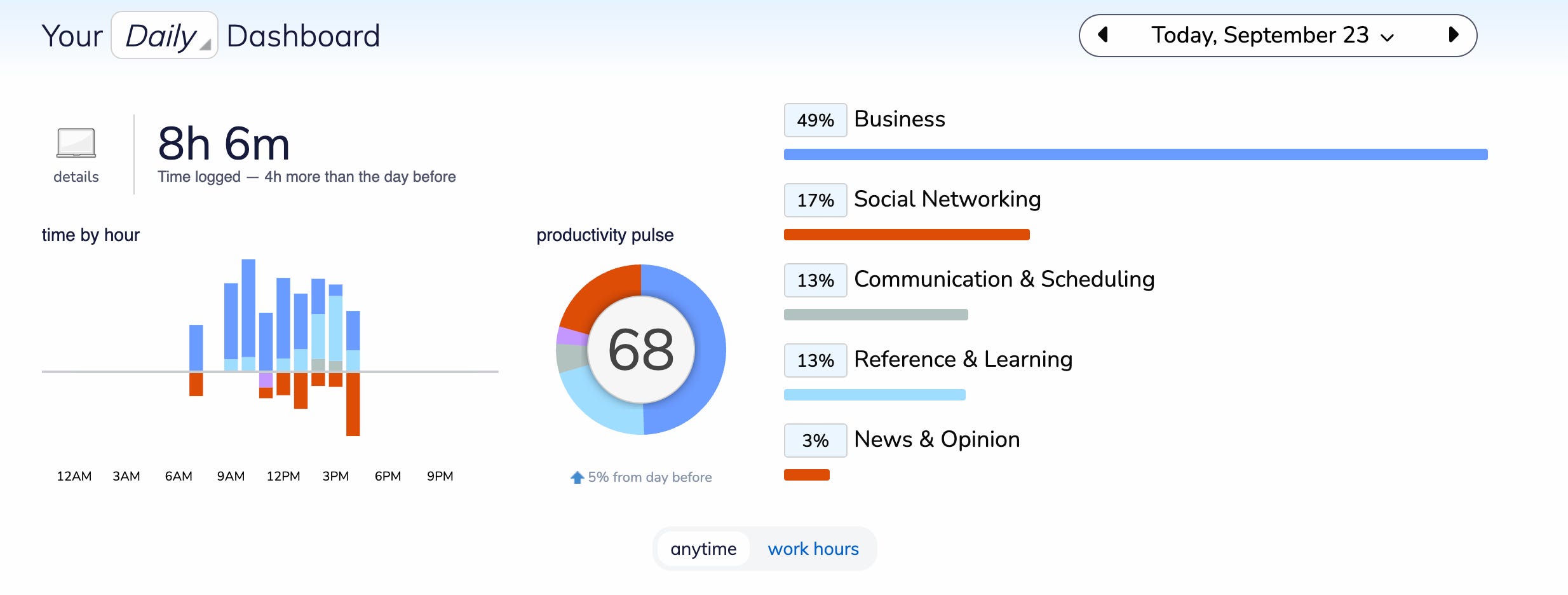
1) Meetings (or anything else that was fabricated to make you look busy): Most readers will not be able to remove them completely… But everyone should at least try to reduce them. Anyone who has worked in a corporate job knows meetings waste time. They are designed to make you look busy. Spending 30 minutes on something that could have been an email instead? You have got better things to do with your life. Don’t forget to run something like RescueTime to get an honest picture of where you are and where your hours are going.
Necessary reality check:
Pull last month’s calendar and measure how many hours went to meetings (or anything else that you do regularly).
Ask yourself how many of those could have been an email instead. Good chance the answer is most of them.
2) Spending your hard-earned money: That doesn’t mean you should live like a monk or get obsessed with being frugal and penny-pinching. But never underestimate the amount of energy that goes into wanting things and falling into the routine of buying what you do not need. At the end of the day, your happiness comes down to 3-5 things, and 80% of it comes from them. Your living space, your bed (you spend a third of your day in it), and your main hobby.
3) Distractions: What you need to learn is how to focus on one thing at a time. No multitasking, unnecessary context switching, or anything else that falls into this category. Great work comes from ruthless prioritization and knowing what deserves your attention. Your phone is both your best friend and your enemy.
Psychologist Gloria Mark, timing office workers with a stopwatch for a 2004 study, found they switched tasks roughly every three minutes, and that by 2012 the interval had shrunk to 75 seconds. By 2022, David Epstein writes, it was about every 45 seconds.
4) Content you consume: Only the vetted stuff should be consumed, and everything else should be ignored. Especially the algorithm-driven material and social media (if not curated properly). Old books, non-AI newsletters, personal RSS feeds, essays. Everything else usually is not worth your time, with a few exceptions. A clear mind will be an unfair advantage over the next decade.
Automate
This used to require a developer and (often) a big budget. Not anymore. Now you can kill most of what you repeat every week in 48 hours using tools everyone already has access to. Why do most people skip it? Because one automation only saves about 20 minutes a week, which feels like nothing. Run the numbers on that, and you get roughly 17 hours a year just on that one thing. Stack a few of those, and it becomes painfully obvious why you want to automate.
Nothing in this section is permanent. Get comfortable knowing you will have to revisit and change all of it as your lifestyle changes.
1) AI and YOU: The weekly report you run, the research you have to do on your product, scanning Slack for context, or anything else you have decided to use AI with. Look at these tools as background operators. Things that help you become more efficient and free up time for what you prioritize above everything else. One way to look at it is from the perspective of what you do not want to do but have to do. Framing it that way forces you to prioritize and get things done even on the days you are not feeling it.
2) Your money: Set up the auto investments and split everything automatically. Investments, savings, business costs, and bills. Set it up once, then forget about it. This removes the energy of the decision and kills any late fees. It is one of those rare automations that compound literally, and everyone will notice the improvement in their life.
3) Anything that is being done regularly: Haircuts (set up a specific time with your barber and make it recurring), grocery orders, a robo vacuum handling the house. Set it up so you don’t have to think about it.
4) Default to whatever buys your life back (your time): Time is one of the most valuable currencies in the world, and once it is spent. It is gone. One way to simplify your life is to always default to whatever gives you more time back. Things you buy, the things you spend your energy on, the things that make you healthier (the longer you live = more time you have). It also pushes you to stop prioritizing things that should not get even a thought of your day.
5) Routine: Same wake-up time every day. Same bedtime. Strict workout schedule. Strict business schedule. The more you manage to pull it off, the easier your life gets. Make it a habit to have a pen and paper and write down everything that has to be taken care of in the next couple of days.
The more details of our daily life we can hand over to the effortless custody of automatism, the more our higher powers of mind will be set free for their own proper work. - William James
Outsource
Most people never even consider this one because they assume it is ONLY for the rich. Wrong. If your hour produces more than the task costs to hand off to someone… Outsource it. Quick math: $10K a month is roughly $60/hour. Every hour you spend on a $20 task is costing you $40. Doesn’t take a genius to realize the math is not working in your favor.
We have talked with hundreds of people at this point who are sitting on $20 an hour tasks, telling themselves they cannot afford to outsource it. Only to find out they are making 5 figs a month. It mostly comes down to programming and inner beliefs. The same ones that keep people doing $20 tasks forever because they are uncomfortable admitting they are past that phase. One way to get the most out of it is to look at it this way: whatever tools or AI can’t handle goes to people.
Where to start:
1) House cleaning: There is no going back once you do it for the first time. Anything you don’t enjoy should be handled by someone else, and this is arguably one of the biggest ones you should attack. The only requirement is that you decide what you will do with your free time once you find someone to take care of this task.
2) Time-heavy tasks that can’t be scripted: Anything AI can’t do (yet!) should be sent to the VA. Don’t trust the VA to do it right? It is time for a specialist. There is really no point in spending hours on something others can do in 1/5 the time. Keep this up long enough, and it becomes obvious that everything in your business that is not the business is basically wasted time. Because every hour you free up by paying others to do it for you means more time to focus on revenue work that matters.
How to get started with this:
Focus on small tasks that break your focus but still take 10-15 minutes regularly.
Before handing anything to your VA (or specialist) → record yourself doing it and create a checklist they can follow.
Be quick to fire if things are not working out.
3) Pay for the knowledge: Luck surface area is one way to describe it. A more precise way would be to call it speedrunning your own experience. No right or wrong answer here. What we can all agree on is that experts know far more than they share publicly, and one way to access that REAL knowledge is to get close to them. Most think this step is about adding things, but it is more about simplifying things for yourself so you don’t get stuck in the loop of nothingness.
200 free hours a year (if you do this right)

The modern world hates an empty calendar
The modern world hates free time and an empty calendar. This is especially true when most of the things on your calendar (what fills it) do not necessarily do you any good. Now throw someone who is not self-aware into the mix, and there is a good chance the calendar gets filled with things that don’t belong there. You cut meetings to free up time, and the old programming immediately pushes you to fill that space with other stuff that may or may not get you where you want to go. This is where it becomes obvious that you will need defense mechanisms to protect that time. Non-negotiables are one name for them. The other half of the story is that you have to be realistic and set your expectations. Because everything you cut will try to get back into your life one way or another.
You will slip
It is unrealistic to claim you will never slip and fall back into your old ways. Not with everything, but definitely with some parts of your life. Usually it is the phone and saying yes to things you should not be saying yes to. Automations are a different story since they are not based on your willpower but on a machine. This is where it becomes crucial to build your own fallback system, something you can lean on to get back on track. It is worth mentioning that you shouldn’t be afraid of having a bad week. Yet you should be afraid of never getting back on track after one. Our advice? Simplify it as much as possible. Build your own checklist so you know what you implemented, how you implemented it, and why. Reflect on it 1 or 2 times per year, and you have already made it much harder to slip.
What happens in the next 365 days
Run the math on everything you do
If cleaning takes 2 hours a week and you can pay someone else to do it. You are looking at over 100 hours a year back. The same logic applies to automations, eliminating meetings, or anything else. You could gain 200-300 extra free hours a year if you do this properly.
The signs you are looking for
More free time on your weekends.
A calendar filled with meetings (not just meetings, but you get the picture) that ACTUALLY matter, not unnecessary yaps that take time.
Fewer decisions to make, but with a bigger impact on what you are doing.
The key areas of your life (health, money, time) are simplified, leaving you more space to make the right decisions.
What those NEW hours are actually for
Building the system you enjoy and can get the most out of. Imagine freeing up 200 hours and then filling your calendar with the things that should not be there. Getting back into the patterns you should not get back to… So the best thing you can do is to decide before you even cut it.
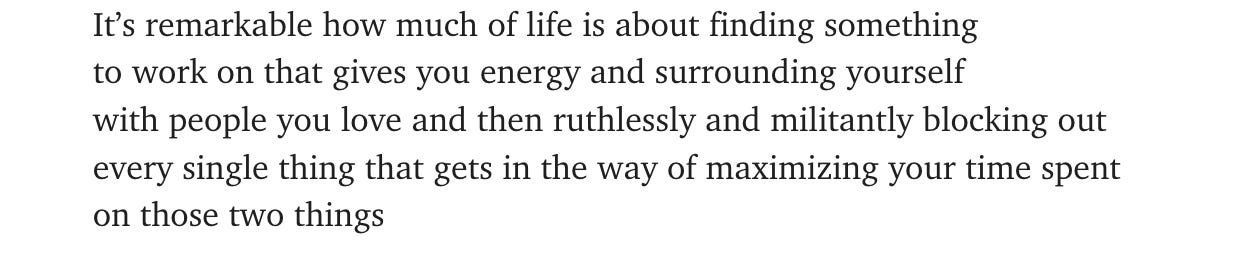
And remember… Never let yourself end up a victim of your own schedule and the lifestyle you are living.
Disclaimer: None of this is legal or financial advice of any kind.