


Housekeeping:
The Mindset Rewiring workbook is becoming a "bundle". With over 5k downloads so far, we have decided to add two more items to make things easier. The update should be out next week. September will also be the last month to get the workbook on Substack, as we are moving it off here.
Be sure to check out the inner circle, as there are new updates.

If you have questions or want feedback, please use the chat. We do not offer standard Q&A for paid subs, so this is the alternative. If your questions are more private or you want to keep it low-key, you can also send DMs. We try to get back to every paid subscriber within 24 hours (many of you can vouch for that).

When was the last time you asked yourself what your perfect day looks like? This post is for those already hitting most of their goals but still feeling like they aren’t getting where they want to be. Most know what gives them energy and makes them feel alive. Yet their Monday doesn’t match that scenario... Or any other day of the week. Maybe the holidays do… The ones you count down to. Living like that day in and day out kills dreams. When your ordinary weekday feels so far from your perfect day, that is a sign something is off. You are optimizing for the wrong things. At least that was the case for us.
The best thing you can do to fight it? It is NOT by chasing another goal list or finding a new hobby that relaxes you. It is about figuring out the gap between where you are now and where you want to be. This post isn’t for people who want a beach lifestyle and think everything will magically work in their favor if they don’t put in any effort. This is not a routine template you have to follow. This is a practical approach (template) for people ready to improve their lives. Their ordinary days and how they do things. Not the vacation days. Not the weekends. But the actual random Monday everyone hates.

You get 25,000 days (if you are lucky)… Most of them feel the same
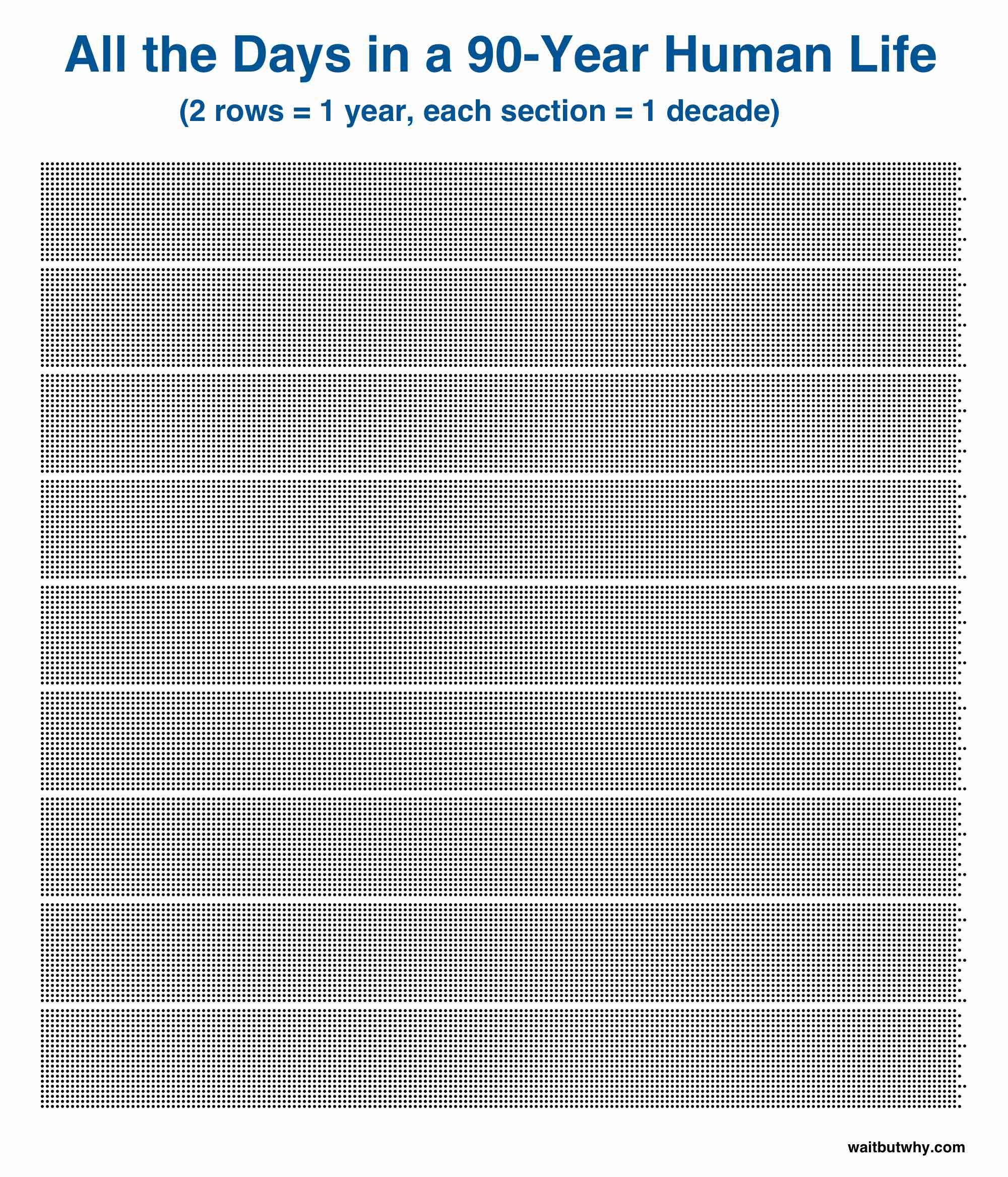
Time is a limited resource, and the more fun you have in life, the faster it starts to feel like it is passing. The above days equation only holds up if you are lucky and your health serves you well. This becomes painfully obvious once you hit your 30s, when weeks start to feel like days. Throw in more obligations or the things you are passionate about... You have the perfect combination to wake up one morning and feel miserable because you feel like you don’t own your schedule.
Chasing goals works for some. Creating systems works for some. Everyone is different. What no one considers is that neither of those necessarily brings you closer to the life you want to live. Yet we spend hours optimizing for them and trying to figure out how to get more out of those.
The painful realization is that your most common day (weekday) is the opposite of what you want. Building the life you don’t want to live to impress the people you don’t want to impress. So why waste your precious time building a life you don’t want?
Perfect day you can't repeat? It is just a holiday

Everyone knows it is one of those days when you are on vacation and everything seems to go your way. You don’t have to check in to work, no alarm clock, no boring emails, and no coworkers you don’t want to spend time with. It is a perfect day… After all.
The hard part is that you cannot delete work, alarms, emails, or other people from your normal weekday. You could, but that means quitting and rebuilding your life. A complete 180 that most people aren’t ready to make.
What you should do is start getting a clear picture of what the perfect day means for you. Consider both the vacation-type scenario where no one is bothering you and the one that still replicates everything you do throughout the week. Start from the perspective of how to make it better and fit your vision. This only became obvious to us once we did it and compared what we do day to day with what we want (our perfect day). Our exercise is an eye-opener because it exposes how you are living day to day and how big the gap is between your ideal scenario and where you are right now.
The strategy that works is the one you can stick to. Not just that, but the one based on your perception of the perfect day and what it means to you. From a psychological perspective, the weekday version makes sense because it is designed to work on a random weekday. No vacations, no weekends, or any other requirements. Your perfect day (or as close as you can get) should be something you can replicate on any random day of the week.
Random Monday? That is your goal. It would be a lie to say it will always be the case. Life happens to all of us. Your strategy and planning should focus on balancing what you know you can achieve with low effort (fits your perfect day) with what you know you can still pull off with a bit more effort (think weekends). Find the middle ground between the two and come up with the scenario you know you can do for the most part.
Where most perfect day strategies fall apart
Work: We already mentioned that a realistic perfect day has to include everything... You work Monday to Friday at the office? Those hours stay in the picture. You might be coming up with your perfect day, but you can’t ignore those working hours. You are not looking for another holiday or something to fill the gap. If you are now barely making ends meet, it would be dumb to think that your perfect day would be off work. Maybe that is the case. But at the same time, it may not be the best choice. Neither is it a realistic one. Work plays a big role in your life, and if you are one of the lucky ones who find something that inspires them, it will change everything for you. You want to have some form of work in your schedule.
Relationships: Another area you want to cover in depth. For example, dinner with friends that leaves you feeling energized and ready to take on other challenges. Add it to the list. Going to the gym with your group? Add it to the list. Anything that gives you a sense of fulfillment and aligns with your perfect day involving others should go on the list. Social connections and relationships play a huge role in life, no matter how social (or antisocial) you are. They have to be on the list one way or another when it comes to your perfect day.
Health: You either get this, or you don’t. Include things that improve your quality of life and make you happier by default. Your perfect day should include an activity or two that helps you be healthier, look better, or be more productive. Walking 10k steps or eating a healthy meal (or not eating anything bad for you) should be the least you can do.
Environment: Big one. Go in depth with this one. From where you spend most of your time to how it looks. Want to go a level above? Start by describing the weather outside and what YOU want. All that sounds ridiculous until you realize the environment either creates you or breaks you. There is power in being surrounded by the things that align with your vision. From the place where you are reading this, the people you surround yourself with, to where you spend your free time. They all shape you. Directly or indirectly. This is why you want a clear vision of where you want to be and what you want to be associated with.
How you feel (mindset): Don’t be afraid to express yourself as you write things down. Does your perfect day involve having coffee in the morning and doing something you love afterward? No problem. How does it make you feel? Energetic? Excited? Ready to work on something you are passionate about? Write it all down. All of those indicate what is worth your attention. They show how the things that bring you so much joy (make you feel optimistic) should be positioned in your life. The more you stack and optimize those, the smaller the gap will feel.
A Monday you would actually want again
The only way to get something out of this is to open your Apple Notes, Obsidian, favorite notebook, or anything else that you are using to take care of your notes, and start writing things down. This should be the next phase once you have a clear overview from the previous step and know which activities you have to do and which you want to do.
Why Monday? It is simple. Can you have a perfect Monday? Often the most chaotic day for most people, Monday means you can make any other day of the week perfect. The only requirement is that you start writing down your vision and engineer what your perfect day would look like. Do this hour by hour so you get a clear picture of what you want and what it looks like. Action by action. Activity by activity. This will force you to think clearly and prioritize what matters to YOU vs. the noise.
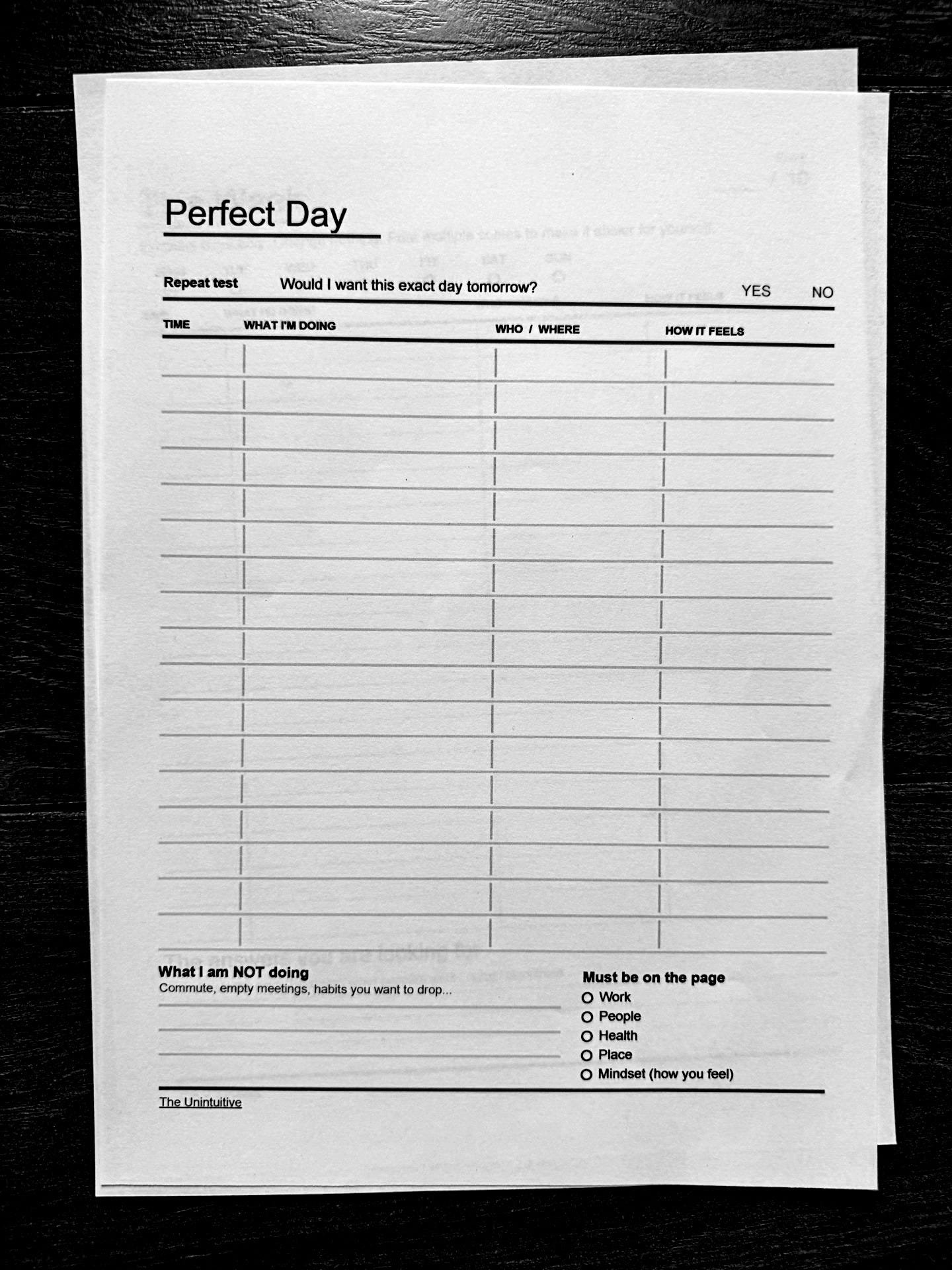
This is how it should look:
7:30 - Wake up. Decided to stick to no phone, made a coffee, and headed out for a short walk.
8:15 - Turned the laptop on and got ready to work. Decided what to work on and sat down to focus.
9:00 - Time for another coffee before taking any calls.
The metric to focus on is the repeat test. What do we mean by that? To get the most out of this exercise (or any other), it is crucial that you can always answer "Yes". If someone asked you whether you would repeat this same day tomorrow, your answer has to be "Yes". If the answer is "No" you have done your planning wrong. This is why it’s important to start including things that might not make sense at first (such as work or things that might not feel 100% comfortable) to form a big picture.
How to get the most out of this
Forget about engineering another holiday day or taking it easy.
Weekends are already a dream scenario, and holiday setup should be off the table.
You want a breakdown from the time you wake up until you go to sleep.
Feel free to create your own template. Whatever works best for you and gets this out of your head and onto paper. It works wonders. For us.
Forget about dumping three hours into one block. Yes, you might work three hours in one block. That doesn’t mean you didn’t enjoy a cup of coffee in between or do 10-20 minutes of stretching/walking. Write it all down.
Remember the framework? Work, relationships, health, environment, how you feel…
To get the most out of these exercises, you want clear answers about the music you hear throughout the day, what you wear, what you eat… Everything. It is all part of your environment. All of that will click later, and you will see why we are pushing you for these answers.
Keep it simple. Write down how you feel and how things make you feel.
Write this from the perspective of having unlimited money. This helps you get a clear sense of what you want without self-imposed limitations. It will also help you to design the life you want to live with far less than you think you need. Because you are not operating out of desperation and neediness.
We have covered this in depth in our mental models.
There is a big difference between writing about the perfect lazy day and writing about a perfect day. Make sure you do not fall into the first category. Because in that case, doing this exercise is a waste of your time.
Prepare yourself for draft versions 2 or 3 to be the best. The initial draft will likely be way too unrealistic. The next one will be more realistic and better. The third one should usually be the best. Can you do them on different days and at different times? This is the best approach. Each time you do it, you will get a different set of answers, depending on how you felt and how your day was.
Want to take it even further? Write down everything you are NOT doing that you usually do. Are you used to commuting 2 hours every day? In this version, you are not anymore. You are not commuting. What about constant meetings that go nowhere? In this version they are gone, or at least useful. Write down the things you are NOT doing. You want to do this because they are usually the easiest to fight or change.
This shouldn’t take more than 60 minutes. But you have to approach it with focus and 110% of your attention… Make sure you use one of your unfair advantages.
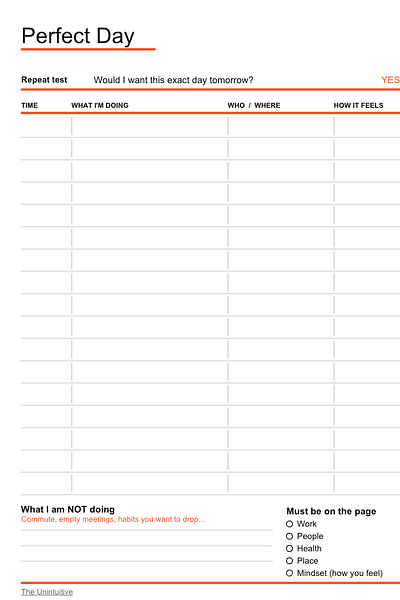
Pages that do the exercise for you (downloadable template you can use)
Track the week you already live
Give yourself at least a week to get the most out of the audit. Over the next 7 days, track everything you do. This is not an easy job. But it is the only way to position yourself and figure out what is robbing you of your perfect day. It might be the commute, it might be working for someone else, or you might be wasting your precious time on things that shouldn’t get your attention. There is a good chance it is a mix of all three.
Take a week. Pay attention to every single thing you do. What time you wake up, how you feel, what you are eating for breakfast, music you are listening to… You want to log everything.
DON’T change anything from what you usually do. This is the most important thing this week. Whatever metric you change will pull you further away from what matters. If you usually go to bed at 11 pm, now is not a good time to start going to bed at 9 pm.
No vacation weeks, holiday weeks, or anything else that is not how you spend most of your year. You want the ordinary week.
Apple Notes, pen and paper, or anything else that works for you. This is how you want to log your stuff. For most people, checking in every few hours will be the easiest way to approach this. One sentence per block (activity) should be all you need. Don’t make it hard for yourself. Keep it as easy as you can.
If you find yourself enjoying this process and gaining insights you never thought of before... This is a sign that you should not take this for granted and with 2 to 3 right moves you might change your whole weekday structure.
Score each day from 1 to 10. Why did one day score 2 points higher than the day before when you did the same things? You will realize how you felt and what caused that feeling. It is one of those obvious signs you should pay attention to, and one reason creating a perfect day comes down to small things you can change.
Be 100% transparent and honest with yourself.
The week you lived Vs. The Monday you designed
Once you finish your current week’s audit, compare your perfect day with where you are right now. Compare it hour by hour. Cover everything that is written down and how it made you feel. The goal is to run through every day you had this week and compare it with your perfect day. How they differ, what you have done differently, and the overall score. This will help you spot patterns so you can chase what you want and build a perfect scenario you can replicate every day.
Once you are done with that part, it is time to figure out what already matches between your current typical day and the perfect one. It might be the walk after lunch, the relationship with people you care about, or a simple coffee in the morning. There are no rules for this. Everyone will have a different answer. Your only goal is to figure out what already matches and what you should not change. Don’t skip this step. It is without a doubt one of the most important steps in the whole exercise because even a small change can affect your quality of life.
One way to approach this is to identify the biggest obstacle. An activity that is the furthest from your perfect day. That is the one you are looking for, and if you manage to fix it, everything else will slowly start to shift in your favor.
Fix the hour that looks nothing like the life you want
Once you have a clear overview of the difference between the two, start with the lowest-hanging fruit. If you know you are doing something that isn’t necessarily good for you, or you are doing it out of habit, now is the perfect time to start and re-engineer your daily reality.
Basic example: Let’s say that in your perfect day scenario you have 20 minutes of reading a book. Maybe on a weekday, the first thing you do when you get home is pick up your phone and let yourself fall victim to the algorithm. Instead, you remind yourself what you want out of life and pick up a book. It sounds overly simplified… But it is how you should approach this.
5-10 small changes like this compound and lead you to a new lifestyle. This is where it is important to understand that some fixable things require low effort and some things will take time, if not years. It also makes sense to sort things into what you can start fixing this week and what will be a long play.
Join the Inner Circle.

We are 100% reader-supported. This newsletter is free. If you want access to everything we make…
The Full Archive: 150+ articles you won’t find anywhere else.
The Toolkit: Our inner circle templates, frameworks, and PDFs.
Total Access: Every future deep dive and resource we publish.
FAQ
How detailed should it be?
Be very detailed. You want to be able to picture every detail. Map it out… Or whatever you want to call it. If you can’t picture what you are wearing, what you are eating for breakfast, or how you are spending your time... It simply means you are not done. You also want to avoid vague answers at all costs.
My lifestyle has completely changed, and my idea of a perfect day is different from what it used to be. What do I do now?
That is normal, and this exercise was never meant to be fixed. Things change, your lifestyle changes, and your priorities change. Does your idea of the perfect day feel completely different? Print the new version and give yourself some time. Audit. Think about it. This progression, including distancing yourself from your original plan, will happen more and more as big life changes occur.
What if my day is full of things I don’t want to deal with, but I have to (kids, family, job)?
That is the whole point. It is also a reminder that to achieve your perfect day without special reasons (holidays, weekends...), you will have to figure out how to make it happen. Building the perfect scenario around your obligations is something not many people succeed at. Take for example a job. If you know you have to be at work at 9 am, and it takes you an hour to get there... There is a good chance that, with your current setup, you will not be able to avoid it. But instead, you should think about how to get the most out of it. Maybe call someone you care about and ask how they feel and what is going on.
How do I check my progress or know that I am doing the right thing?
The key is not to treat this exercise as something you do once and forget. The best approach is a weekly 20-minute check-in where you reflect on what moved you closer and what pulled you back. Reflect on how you are sticking to the routine and whether you are seeing progress.
What if the people in my life don’t share the same idea of the perfect day as me?
They never will. Why would you want everyone to share your idea of the perfect day? Keep in mind that your version is the one you are being honest with yourself about. Not something others think is right. But something you want deep down. This is also where the real relationships with those who are good on paper become obvious.
What is the best way to start closing the gap?
Identify the biggest obstacle and solve it.
Once you do that successfully, things will start to shift in your favor because you removed the biggest friction.
Your environment (change it)
Start changing the small, meaningful things you can control. When it comes to the environment and how we define it. We could further break it down into physical, digital, and social. All you have to do is fix one thing in one of the three we mentioned, and you will notice the difference.
Look for the things you do not want to do but do regularly because you don’t have a choice.
How to know it’s working?
The success of this exercise only becomes apparent after you realize that, instead of having 0 days that look close to your perfect scenario, you have 1 or 2. It might not sound impressive... Yet that is what you are looking for. The more realistic case is that you no longer dread any days and that the gap is smaller, or at least that more of the day’s activities look like the ones you want. Your goal should not be to believe that you will achieve success in the next month or two. It should be that you find yourself living more days and doing more things closer to what you WANT to be doing. That is the real metric and the only measurement of success worth paying attention to.
The next thing that will happen is that you might miss a weekly check-in and the time will pass… You will forget what you were even doing or what your perfect day looks like. This is normal. Start again by auditing your day. Another thing you could do is pick one or two things from your perfect day and do them. Get back into the moment. Remind yourself why you are doing everything you are doing.
The people who will get the most out of this are those who actually do everything we outlined here and take their time. This is not an easy exercise. It is more of a process. Write out your Monday, think about how your perfect life should look or where you are right now as you write this. The positive? It is not complicated, and it doesn’t require anything you don’t already have. A printer if you want to make it easier for yourself and use our template…
To build your perfect day, you need to know what it looks like. Have an overview of the gap between where you are now and where you want to be, and how each change affects where things are moving. Be honest with yourself, pick one thing, and start playing with it. Over time, you will notice that things start to work in your favor, and you will be in a different position than you were before doing this exercise. You might even live your perfect life…
Enjoy your weekend.
Disclaimer: None of this is to be legal or financial advice of any kind.
great read on sunday morning! I'm gonna do this exercise next tmr. Thank you for sharing this
I am taking this article as financial advice